Most productivity systems eventually fail for me because they become another thing to maintain. I spend more time organising work than actually doing it.
The reason I’ve stuck with the Dash Plus System for so long is its simplicity. It gives me just enough structure to capture tasks, notes, and decisions throughout the day without turning into a full-blown task manager.
The system is based on Patrick Rhone’s Dash Plus system, along with ideas from his article on extending Dash Plus.
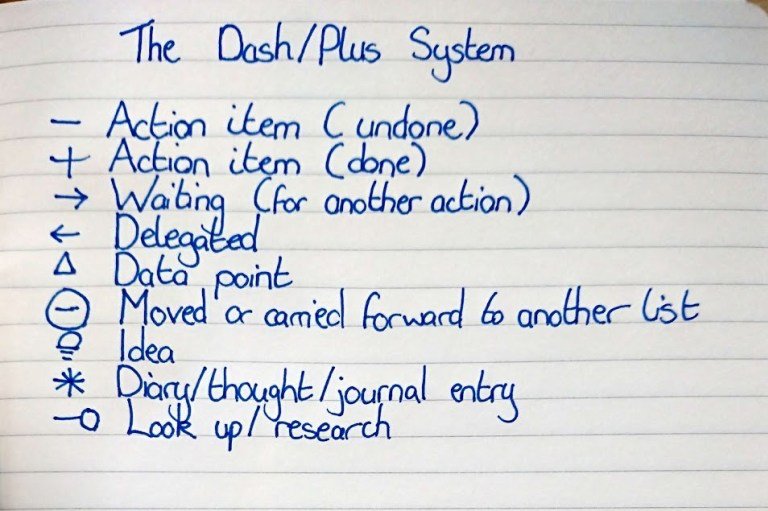
At its core, Dash Plus is a daily page containing a mixture of tasks, notes, reminders, and observations. Rather than maintaining complex project hierarchies or task structures, everything starts on today’s page.
What makes it useful is the constraint. Each day gets a small, bounded space. Unfinished tasks have to be consciously carried forward, completed work is clearly marked, and decisions are recorded close to the work that prompted them.
The exact notation isn’t particularly important. The value comes from a few simple principles:
- Keep the daily note easy to start.
- Capture tasks and decisions while they’re fresh.
- Carry unfinished work forward deliberately.
- Review notes regularly and close or remove stale items.
For me, the daily page acts as a lightweight record of what I’m actually working on. It’s often more useful than a traditional task list because it also captures context: decisions made, conversations had, and small pieces of progress that would otherwise be forgotten.
Dash Plus works best alongside a project-level system. The daily page is for the work immediately in front of me. Longer-term plans, reference material, project documentation, and completed decisions belong with the project itself.
I’ve tried plenty of productivity systems over the years, but this one has lasted because it asks very little of me. The overhead is low, maintenance is minimal, and it helps me focus on the next useful action rather than maintaining the perfect organisation system.